Let Geo LEED The Way
LEED v4.1 significantly shifted how the USGBC measures building efficiency by introducing updated baselines (ASHRAE 90.1-2016) and moving to a dual-metric evaluation of both Energy Cost and Greenhouse Gas (GHG) Emissions.
Because ground source heat pumps fully electrify the building's thermal load and consistently outperform air-source equivalents, they provide engineers the efficiency increases required to close the delta against the stringent new baselines, easily securing top 18-point brackets while excelling in the GHG emissions metric.
In previous iterations of the USGBC's LEED standard, installing a Ground Source Heat Pump often provided a path to achieving significant point thresholds within the Energy & Atmosphere category.
Under LEED v4.1, the evaluation framework has evolved to reflect new performance baselines and a heightened focus on building electrification. While ground source heat pumps remain a highly effective mechanism for LEED certification, securing those points now requires precise modeling and adherence to updated parameters. Here is an objective overview of how modern geothermal designs perform under the current standard.
LEED v4.1 fundamentally shifted how buildings prove efficiency by moving to a dual-metric approach. Projects are now evaluated on both Energy Cost and Greenhouse Gas (GHG) Emissions.
This is where geothermal consistently outperforms fossil-fuel baselines. While natural gas can occasionally be cheap enough in certain regions to dilute the "Cost" metric advantage, a GSHP systems' core ability to fully electrify a building's heating load means it greatly reduces the modeled GHG emissions metric.
The threshold for earning points is higher than ever. Compliance models must now outperform the ASHRAE 90.1-2016 baseline (or later, depending on local code adoption thresholds).
Because standard baseline HVAC systems mandated by 90.1-2016 are inherently much more efficient than the old 2007/2010 baselines, marginal improvements via slightly better air-source models yield diminishing returns. Ground source heat pumps provide the significant increases in COP and EER required to create a wide enough delta to hit the highest 18-point brackets.
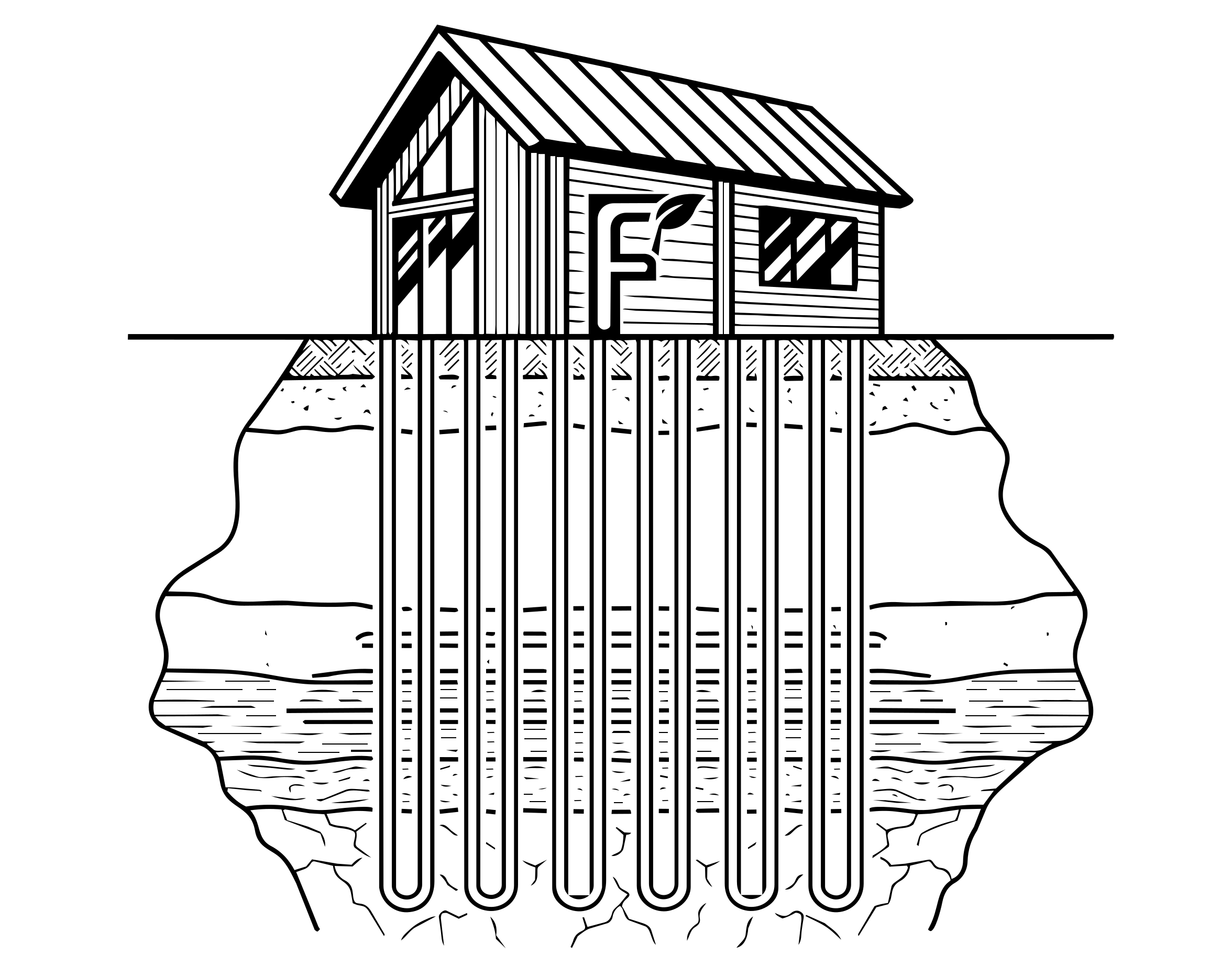
A common error submitted by engineering teams is attempting to classify a closed-loop geothermal HVAC system under the "Renewable Energy Production" credit.
USGBC explicitly views GSHP loopfields as ultra-efficient heat sinks, NOT renewable energy generation. They use electricity to move heat. They do not generate electricity.
Geothermal energy is only considered "renewable" by LEED if a project taps into deep, subterranean high-temperature steam or water to generate power. Standard GSHPs must be routed strictly through the Energy Efficiency modeling pathways to prevent documentation rejection.
As the industry pushes toward Variable Refrigerant Flow (VRF) systems to hit electrification goals, VRF projects are increasingly failing the Enhanced Refrigerant Management credit requirements due to the sheer volume of high-GWP refrigerant circulating through the building.
GSHPs offer a distinct advantage here. While they are highly efficient, the primary HTF running throughout the campus or property is just water (or a water-Antifreeze mix). The actual refrigerant charge is confined to factory-sealed boxes inside the heat pumps, dramatically lowering the overall Global Warming Potential (GWP) footprint of the mechanical system.
Designing a LEED-certified building in the v4.1 era demands a rigorous approach to energy efficiency and decarbonization. While the path to top-tier points is steeper than ever, ground source heat pumps remain the industry's most reliable engine for exceeding stringent ASHRAE 90.1 baselines, optimizing the GHG metric, and cleanly managing refrigerants.
By pairing advanced building envelopes with localized loopfields, architects and engineers can turn the earth into a vast thermal battery, ensuring their projects not only achieve certification but lead the way in true, sustainable operation.
Central Reference Data
The following bodies outline the standards referenced inside this guide.
USGBC LEED v4.1
The official reference guide for Building Design and Construction (BD+C) criteria.
Explore USGBC Standards →ASHRAE 90.1
Energy standard baselines dictating the minimum efficiencies for commercial buildings.
Review ASHRAE 90.1 →FORB
Professional software for properly sizing and balancing closed-loop geothermal designs.
Explore FORB →