How Ground Source Heat Pumps Work
Ground Source Heat Pumps (GSHPs) operate as highly efficient thermal "middlemen," leveraging the stable temperature of the earth to move heat rather than generate it through combustion.
By utilizing a simple vapor compression cycle—exactly like a household refrigerator—these systems can either extract heat from the ground during winter or reject heat into it during summer, providing both heating and cooling from a single, electrically-powered unit.
The Boilerplate Answer vs. Reality
A heat pump is a mechanically simple system that is conceptually difficult to relate to. The boilerplate answer for how geo works is...
“We take heat from the ground and dump it into the house in heating mode and we take heat from the house to dump into the ground in cooling mode. Because the earth has a near constant temperature geo allows us to use less energy in moving this heat than an air source heat pump.”
That doesn’t really answer the question of how the heat pump works but it seems to satisfy the majority of people. Without getting into too much detail, here is basically how a heat pump works.
1. Heat can only travel from high Temperatures (sources) to low temperatures (sinks).
2. Heat can not travel if there is no difference in temperature between the source and the sink.
3. Everything inside the heat pump is in a closed system.
4. In a closed system the amount of fluid contained is unchanging.
The Ideal Gas Law (P·V=n·R·T)
The ideal gas law is the key to understanding the Vapor Compression Cycle. Ground Rules #3 and #4 make our life much simpler. The fact that we are operating in a closed system means that Volume (V) and moles of fluid (n) are constant. Since R is also a constant,Pressure (P) and Temperature (T) are the only two terms that can change in our equation, and they are directly related.
In other words, when pressure increases, so does temperature. This is the key to understanding vapor compression cycles. You can change the temperature of a fluid just by changing its pressure.
The purpose of a heat pump is to move heat from where it is, to where we want it. For a heat pump to move heat, there must be a difference in temperature between where the heat is, and where we want it to go.
The heat pump is the middle man in a system containing a low temperature sink, a high temperature source, and the heat pump itself. The heat pump moves energy from the source to the sink using a 'working' fluid. A perfect example of this in action is your home refrigerator.
1. Compressor
Increases the working fluid's pressure to raise its temperature above the kitchen's.
2. Condenser Coil
This coil outside the fridge circulates hot working fluid, rejecting heat into the kitchen.
3. Expansion Valve
This de-pressurizing nozzle reduces working fluid temps so heat can be picked up from the inside of the fridge.
4. Evaporator Coil
This coil inside the fridge circulates cold working fluid that picks up heat from the inside, thereby cooling off the contents.
Now that we have covered the basics we can relate it to a geothermal system. In addition to the heat pump we also need to define two more components: the conditioned space and the ground heat exchanger.
- The Conditioned Space: The inside of your home. It has a fluid (either air or water) that we want to heat or cool. Assuming we are using a water-to-air heat pump, this is the air inside the home.
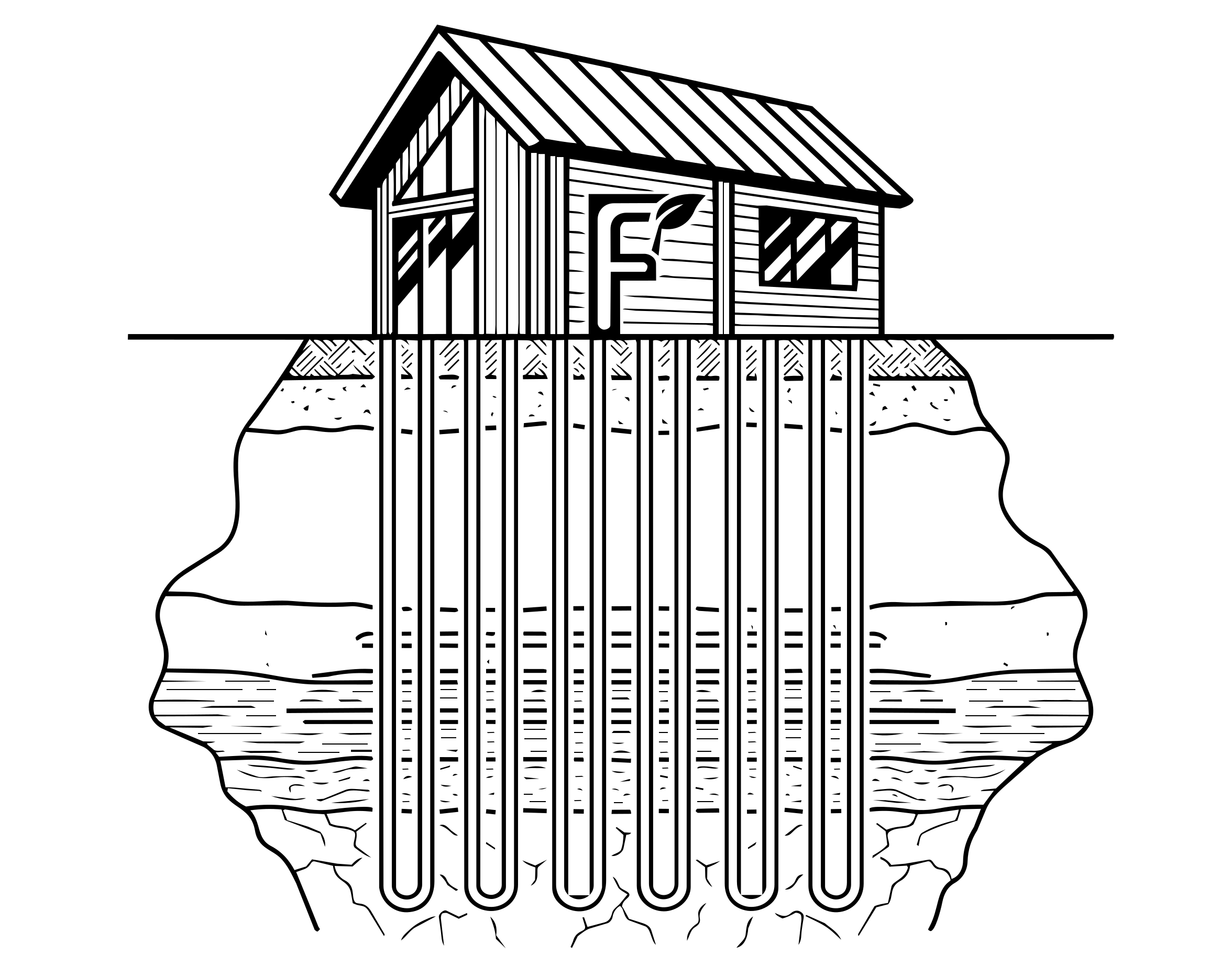
- The Ground Heat Exchanger (Loopfield): The system of pipes installed in the ground containing an entirely different loop fluid. The loop fluid's job is to facilitate the transfer of heat between the ground and the heat pump.
Heating Cycle
1. Compressor: Raises pressure of the heat pump fluid which raises its temperature.
2. Condenser: The hot vaporized fluid is pumped through the condenser. Air to be heated flows across it, condensing the fluid to liquid and warming the air.
3. Expansion: The liquid fluid goes through the expansion valve which cools it down to a liquid/vapor mix.
4. Evaporator: Cooled fluid flows through the evaporator coil while warm loop fluid (from the earth) flows around the coil. The loop fluid is warmer, so the heat pump fluid safely evaporates and picks up the heat.
Cooling Cycle
1. Compressor: Raises pressure of the heat pump fluid which raises its temperature.
2. Condenser: The hot vaporized fluid is pumped through the condenser. The loop fluid (from the earth) flows across it, absorbing the heat to reject into the ground.
3. Expansion: The liquid fluid goes through the expansion valve which cools it down to a liquid/vapor mix.
4. Evaporator: Cooled fluid flows through the evaporator coil while warm air from the space flows around it. The air is cooled and delivered to the home while the fluid evaporates.
Copyright © 2012 by Verdant Labworks. All rights reserved.
To model these cycles effectively in your engineering workflows, visit FORB.